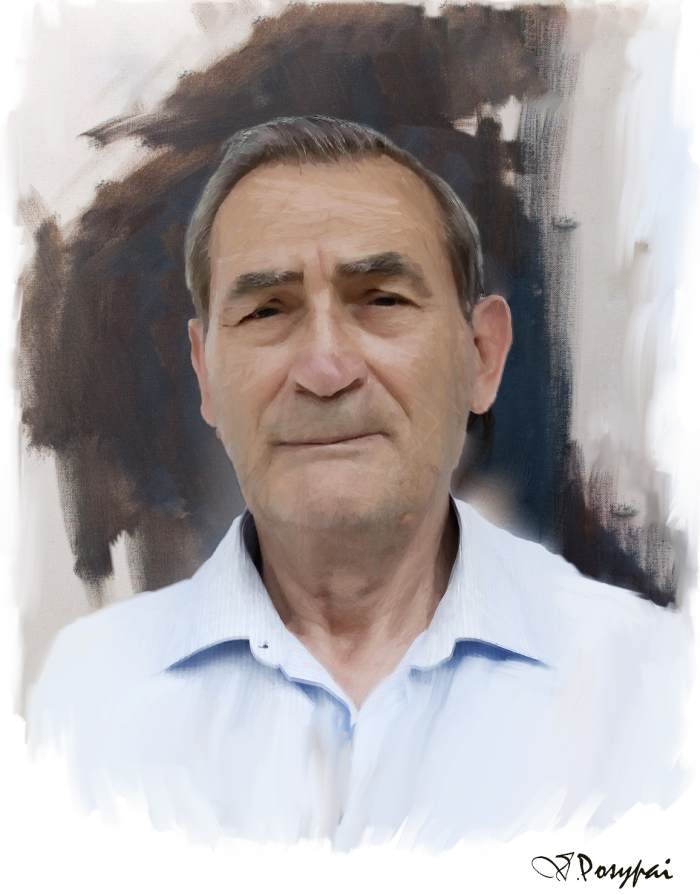
Self-portrait, 2023
Self-portrait, 2023
Volodymyr Posypai is a Ukrainian painter, of self-made origin, with an
extraordinary drawing ability. He is most known for his landscapes and
vedutas in watercolor and oil.
In 2014 he moved to Slovenia.
Born as Vladimir Grigor'evič Posipaj (Владимир Григорьевич Посыпай) in
Mariupol, Ukraine on 27 March
1954. His father Grigorij and his mother Ekaterina both worked in
Azovstal,
father as a principal mechanic. At the age of 4 Vladimir's family, including
his 10 years older brother Anatolij, moved to
Alexandria, the father's home town.
Despite tiring profession of the parents, the home was full of artistic spirit. The father
had an absolute pitch, a beautiful strong voice, he played many musical instruments, especially
the mandolin, which he never parted with, while mother created embroidered shirts. In such
a milieu of enchanting melodies of Ukrainian folk songs and magical combinations of colors
and weaves of ornaments a passion for drawing bewitched Vladimir.
The father did all he could to help the son develop his drawing talent.
He ordered by mail the best oil paints, expensive and valuable books on fine art,
facsimile reproductions of masterpieces from the Dresden gallery, he
created baguette stucco frames for copies of the great masterpieces of painting, made by the
young painter. Following his father's example Vladimir was later also creating baguette frames, of any
complexity, for his paintings. The walls of the parental home were full of paintings, among
them were also the original works of famous Soviet painters, which the father was able to
purchase.
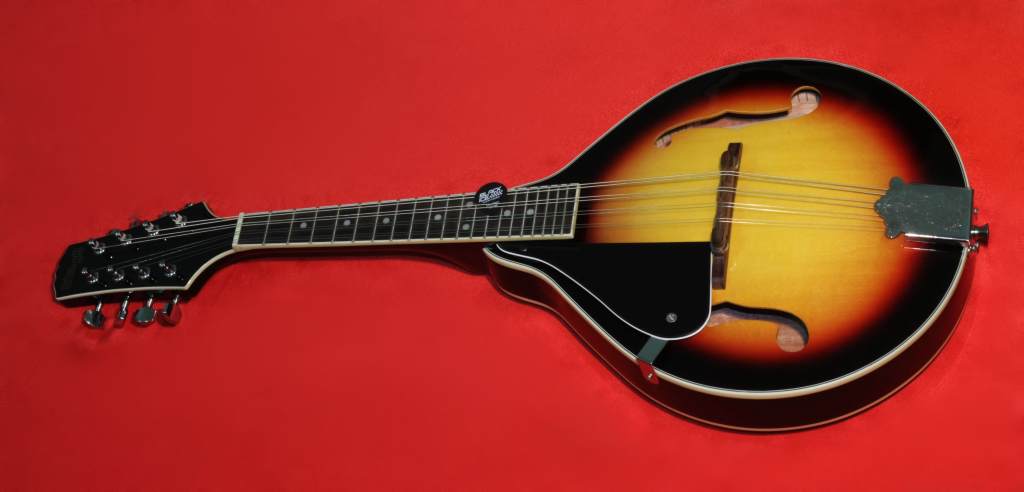
Mandolin (Wikimedia Commons)
Vladimir grew up as a quiet rebel, was not an
Octobrist,
not a Young Pioneer, did not join the
Komsomol, he did not recognize communist holidays
and events. This way the life was not easy, but the ability to draw always helped out.
While still a high school student, he entered and in 1971 graduated at the Moscow
People's Correspondence University of Arts in the class of painting.
He started to work as a graphic designer. In 1972 he participated
at the All-Soviet-Union Festival of Arts in
Leningrad and I received a diploma of a
laureate and a Grand Prix for a self-portrait (now lost) in oil. It was his last participation
in exhibitions.
In 1973, with two more artists, he opened an art school and worked as a teacher of painting and
sculpture. In 1975 he enrolled in the correspondence department at the Art and Graphic faculty of the
Herzen Pedagogical Institute in Leningrad. After half a year,
Vladimir moved to the Faculty of Painting of the
Leningrad Academy of Arts.
Two years later, his rebellious character could no longer cope with the ideological
framework of the Academy and he was forced to drop out of it.
Vladimir remained engaged in very different things, and all had the most inconsistent relation
to art and creativity. From 1980 to 1987 he worked as a creative artist at the Kiev Art Production Office.
He painted huge paintings for clubs, palaces of culture, music schools, high schools and colleges,
painted many portraits of cultural celebrities. He was engaged in sculpture, metal-plastics and
also in the ancient technique of encaustics.
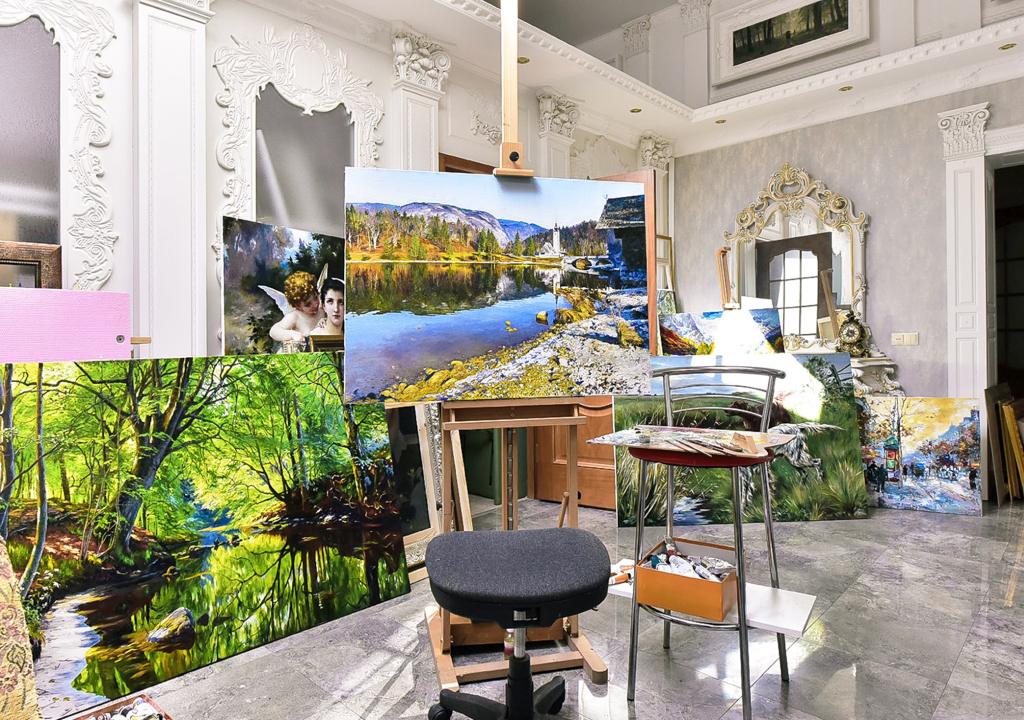
His studio in Ukraine
Very special tasks were monumental painting and sculpture. In 10 years of work
with the drama theaters of the former Soviet Union, more than 30 large theatrical backdrops of 200 m2 in
size were created, and many pieces of other scenery for 13 staged performances. The main difficulty
of such decorations lay in their style, in those
years in the Soviet Union there was only one official style - realism. Simultaneously with such
serious work, in all that time he was also busy with billboards for the cinema network.
It was about 15 thousand canvases measuring 2 x 3 m each, all in the same
realism. Hard times, 10 years without
holidays and days off, cinema can't wait!
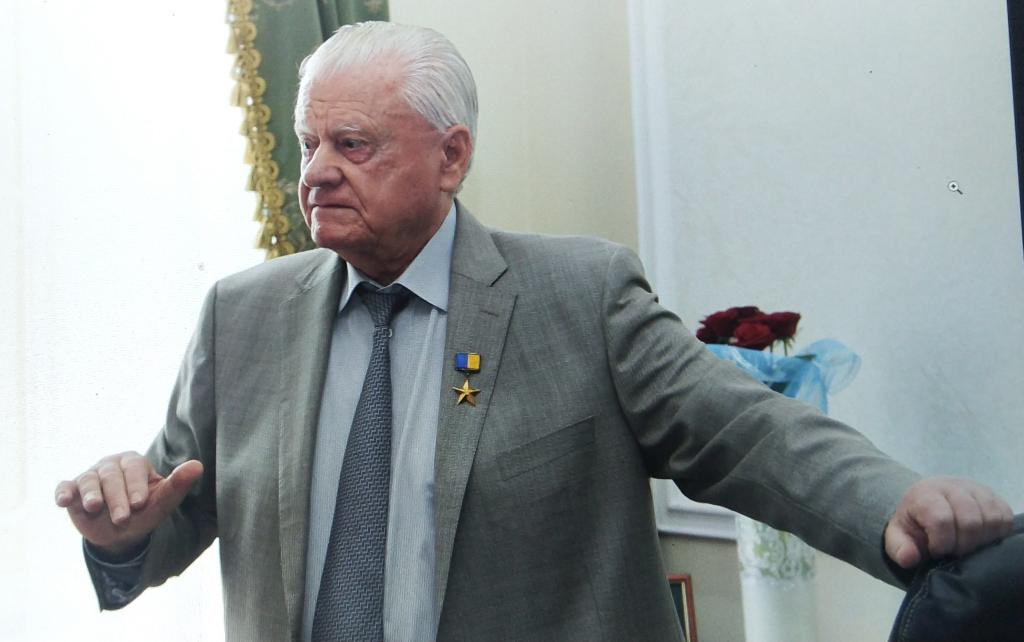
Leonid Grigorievich Jakovishin, Vladimir's main supporter
The collapse of the Soviet communist universe saved him! The artists, as well as the entire intelligentsia,
were thrown out of job, into the street. It turned out to be the best time of his life.
At first, he opened the country's first art cooperative, DECOR (1991 - 1994), but the authorities
practically didn't let him work. Oddly enough, he did not care much, the main thing was that the
artists got freedom. He could do whatever he wanted, he painted still lifes and beautiful nudes in a rush,
lots, very fruitfully.
In 1989, he took up a radically different activity, realized his old dream - a recording studio.
It was not difficult, since 1980 he put together a large collection of art-rock music. It was huge,
and most importantly of the highest quality possible, vinyl discs from "Arista Records",
all brought by diplomats from the United States. The collection also included professional
recording equipment of the highest quality, completed with pieces bought throughout the former
Soviet Union. There were only three such studios for the entire ex-empire, one in Moscow, one in Tbilisi
and his in Alexandria. It was the most wonderful time in his life, for not a lot of money people could
get access to the world's musical culture and he was part of it.
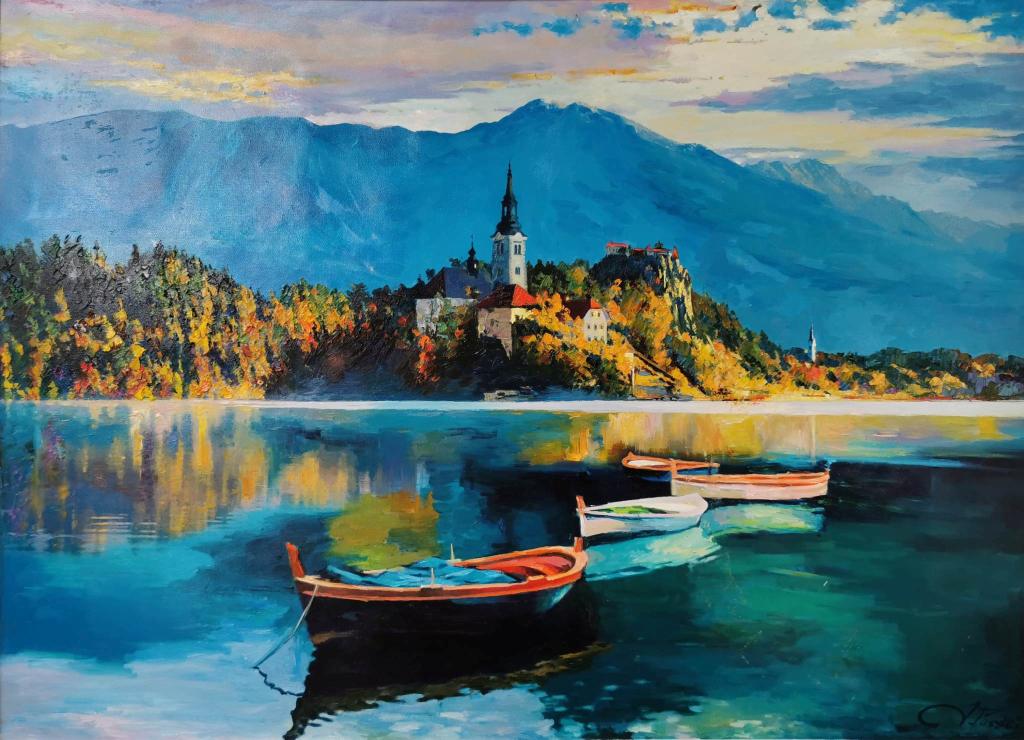
Lake Bled - view of the island from the southwest, oil on canvas, 57 x 79 cm, 2023
The Maidan Revolution in 2014
was a liberating event, moment of joy to which generations of people in Ukraine were looking forward to.
But as it so often happens it could not pass without collateral damage.
The art market was affected to such an extent that Vladimir was forced to
search for his fortune elsewhere. By far the best choice for an aspiring painter would be the
metropolis of art such as Paris.
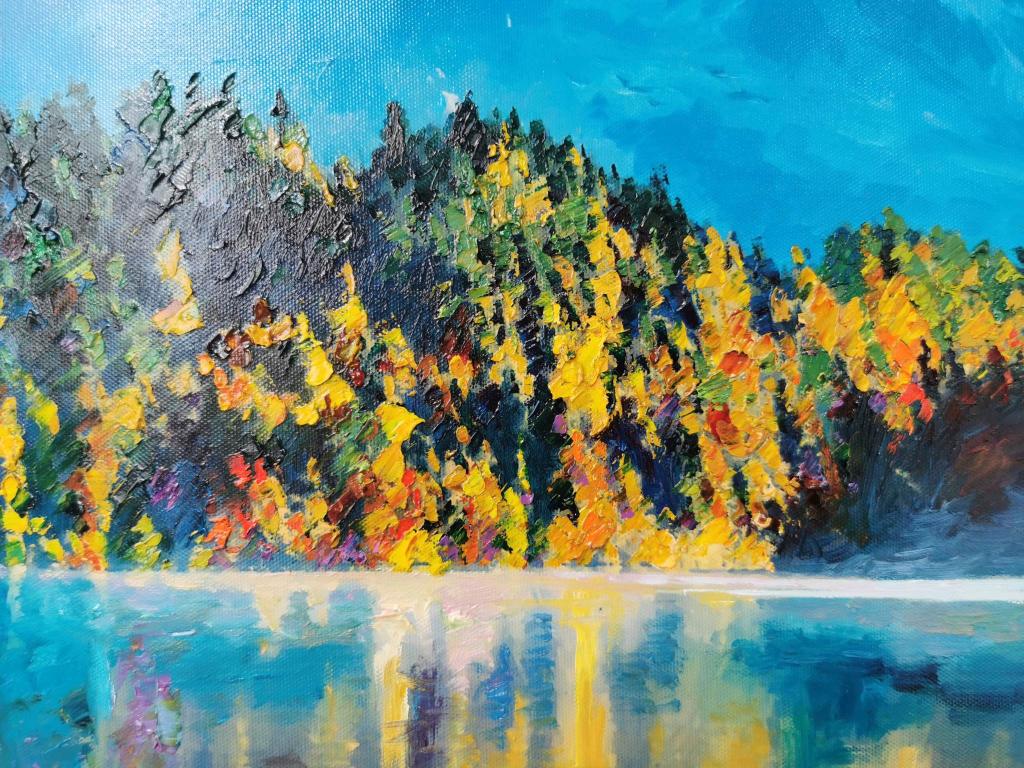
Lake Bled - view of the island from the southwest, detail, 2023
Yet the bedlam, topsy-turvyness, chaos and commotion of such a place are
not for an artist of age. The countries immediately to the west were not
sufficiently attractive, Alpine countries with scenic lakes such as Austria and
Switzerland attracted several of Vladimir's peers. But for him they were, again,
somewhat dull, stodgy. He chose Slovenia for several reasons. One is the same
ancestry - Slovenes (Slavic people) moved to
ex-Yogoslavia a millenium and a half ago from the steppes of the space between the Carpathian mountains
and rivers Visla, Dnieper and Dniester, what is now Ukraine. The second was the
sheer beauty of the land - Bled and Bohinj are among the finest Alpine lakes,
if not quite on top (the focus of Vladimir's current landscape work), there is
the cozy Ljubljana plain with hills to the south and high mountains to the
north, there is the sea coast. All within close, easy reach. And the third
reason was people. Immigrants are nowadays not welcome in most places, he
traveled to the west many times before and could feel the attitude, also to the
people from the east of Europe. But not in Slovenia. Not a single time.
So, if asked why he now lives in Slovenia, his answer is: "How could I not?"
Instead of exhibitions his works are now kept in private collections on all
continents of the world, of the countries especially in the United States,
Canada, China, Japan, South Korea, India, Australia, Brazil, Argentina, Mexico.
In Europe mostly in the United Kingdom, in Italy, France, Germany and Austria.
He, in his own words, used similar approach as the director of the Moscow music
record company Laskovy maj, Stepan Ražin. In his spare time he took a suitcase
of tape cassettes with music sold by his company to the Moscow railway station
and gave away free samples to the departing passengers. They took the cassettes
to all the parts of the Soviet Union and Laskovy maj was a well known brand all
over the country, just not in the home city.
Vladimir has daughter Inga, 1976, and granddaughter Anastasiia, 2005, who is
on the path to a career in painting, too.
https://www.posypai.eu/site_cookies_en.php
About Volodymyr Posypai. updated 21.6.2024.
190